Cell Phones, Starbucks, and Google
Our culture seems to be more stressed, rude, and oblivious than ever. iPhone, Blackberry, Starbucks, Google, these are some of the things that come to mind when I think of the staples of our generation. They are the trademarks of our modern society. They may even come across as perpetrators to people like me who long for simpler times and deeper connections. In my quest to find how to cope with the constant changes of our fast paced, high tech world, I discovered the stories of three guys who know a thing or two about the subject.
Martin Cooper introduced the first cell phone in 1973. Although Cooper acknowledges all the good that has come from the development of this life changing invention he is the first to admit that many habits of individuals on cell phones are rude, annoying, or flat out dangerous. He rants,
“Whatever happened to courtesy? What can be so urgent that you have to look down at your phone in the middle of a dinner conversation with people who matter to you? You can’t wait five minutes before staring at your phone?” and in an interview with Bob Green of CNN he says
“You should not be a slave to your telephone. The technology is there to serve you, not the other way around. If the technology is not making your life better — if it is robbing you of experiences in the real world that you would otherwise be enjoying — then you are working for it, when it should be working for you.”
“Whatever happened to courtesy? What can be so urgent that you have to look down at your phone in the middle of a dinner conversation with people who matter to you? You can’t wait five minutes before staring at your phone?” and in an interview with Bob Green of CNN he says
“You should not be a slave to your telephone. The technology is there to serve you, not the other way around. If the technology is not making your life better — if it is robbing you of experiences in the real world that you would otherwise be enjoying — then you are working for it, when it should be working for you.”
Howard Schultz is the man that transformed a little coffee bean roaster into a coffee shop that we know as Starbucks, the largest coffeehouse company in the world. It was Schultz’s dream that Starbucks be the third place between home and work. He has described the company as an extension of your front porch where people come together to connect. Schultz stepped down as CEO in 2000 and overtime the front porch turned into what I’ve seen referred to as the evil empire. From drive-thrus to automated espresso machines, the once quaint coffee nook was expanding rapidly, and becoming more like a fast food joint. In 2008 the board reinstated Schultz as CEO. Schultz recently released a book called Onward: How Starbucks Fought for Its Life without Losing Its Soul and in it he says “One cup. One customer. One partner. One experience at a time. We had to go back to what mattered most.”
Eric Schmidt has been the CEO of Google for the past 10 years. If anyone knows about being wired it would probably be him. In his commencement address to the 2009 graduates of the University of Pennsylvania, he talks about all the technological advancements that have been made at the university over the years and many that he had been a part of. But what he shares with the students at the very end of his speech is what will probably stick with them for life. “Turn off your computer. You’re actually going to have to turn off your phone and discover all that is human around us,” Schmidt urges them.
“Nothing beats holding the hand of your grandchild as he walks his first steps.”
Whether it is the inventor of the cell phone, the founder of Starbucks, or the CEO of Google, it seems the message is clear. All the technology, success, or information in the world will be of no value if we can’t stop and connect with what matters most.

 Then I moved away, and we gradually lost touch. Addresses, last names, and phone numbers changed and I didn’t talk to them for years until myspace came along. Thanks to the connectivity that we have through the internet I know that Melissa has two beautiful girls and Katie has a sweet baby boy. Because of Katie’s blog,
 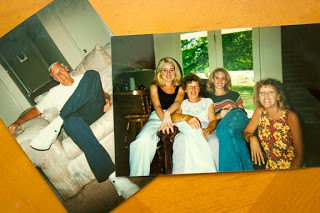 I wouldn’t have known any of this before social networking and I would be left with our memories, and just hope that they were all doing well. So, I will be the first one to vouch that being connected is not a bad thing, but where do we draw the line? That is what I am currently trying to find out.
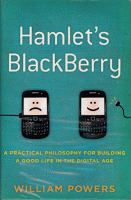 In this book, by William Powers, he looks at the state of a generation entangled in hyperconnectivity and then compares it to that of seven different great philosophers from the past. As each chapter unfolds we find out our situation is not all that unique. For example on page 93 in the chapter about Plato & Socrates we learn “Even writing was once considered a new technology and just like many other new things it wasn’t as obvious of a step forward as we see it today. Socrates writes of the king’s view of this tool by saying that ‘writing is a dangerous invention, because it doesn’t allow ideas to flow freely and change in real time, the way they do in the mind during oral exchange. Whereas conversation is all about back-and-forth, written language is a one way street: Once a thought is written down, it’s frozen and you can’t challenge it or change it’s position. It’s a record of ideas that already exist, rather than a way of creating new ones.’ Thinkers have been analyzing and debating this passage for ages, because Socrates got it so wrong. His reaction to writing is typical of the confusion and anxiety new technologies often cause.” Along with this excerpt from the book I scribbled loads of other quotes on scraps of paper that are now scattered about through drawers and old notebooks. This was my way of trying to cram every thought provoking point from the book into my head, primarily so that I could relay it to you. I highly recommend checking out Hamlet’s Blackberry and I hope you will join me by sharing your own opinions and stories this week as I talk about the high tech, over stimulated, plugged in generation that we are all a part it and whether or not the perceived problem is in fact a problem.







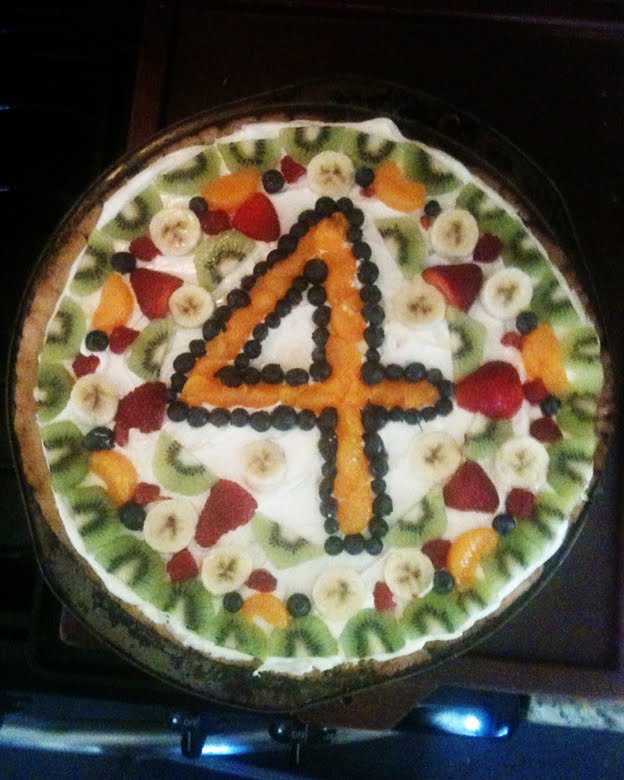
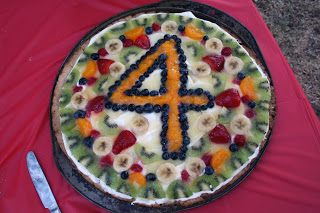
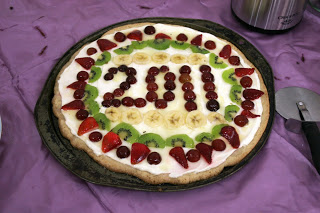 This 2011 pizza was for a class of ’11 graduation party
  and the #4 (shown at top) was for my son’s 4th birthday.